

The Oldest Problem in Trade (And How Matching Finally Solves It)
In 1875, an economist explained why barter rarely works: you have to find someone who has what you want and wants what you have. A Nobel-winning economist later showed how matching can solve it. Here's the problem, the breakthrough, and how TBBN applies it to everyday trades.
By Promise Ebere Okoroji · · 7 min read

In 1875, the English economist William Stanley Jevons published Money and the Mechanism of Exchange, a book that shaped how generations of students learned about money. Early on, he described the central difficulty of barter. To trade without money, he wrote, there must be "a double coincidence, which will rarely happen." (Jevons, 1875)
Economists have called it the double coincidence of wants ever since. It's the main reason textbooks give for why money replaced barter.
But Jevons noticed something else in the same chapter. He described a weekly newspaper of his day where readers posted things they wanted to swap, and observed that, judging by its success, the printed page could bring about the double coincidence to some degree. In other words, even in 1875, the problem looked less like a flaw in trading and more like a problem of finding each other.
A century and a half later, that's exactly how it's being solved.
What the double coincidence of wants means
Say you have a guitar you no longer play, and you want an amplifier. For a direct trade to happen, you need to find someone who:
- has the amp you want, and
- wants a guitar like yours, and
- is close enough, and ready at the same time.
Finding someone with an amp is easy. Finding someone with an amp who also happens to want your guitar is much harder. Each condition shrinks the pool. In a small town, or a single online group, the odds of all three lining up are low, and most potential trades never happen.
Money solves this by splitting one hard trade into two easy ones. You sell your guitar to anyone who wants a guitar, then buy an amp from anyone who has one. Nobody needs to want what the other person has. That's why, as Jevons argued, money became the go-between in almost every exchange.
The problem never really went away
Money didn't make the double coincidence of wants disappear. It just made it irrelevant for most purchases. But some exchanges can't use money at all, and there the problem stayed very much alive.
The most striking example is kidney donation. Someone who wants to donate a kidney to a loved one often isn't a medical match for them. Buying and selling kidneys is illegal, so money can't bridge the gap. For years, that meant willing donors and patients in need simply couldn't help each other.
The economist Alvin Roth, who later shared the 2012 Nobel Memorial Prize in Economic Sciences for his work on market design, recognized this as a barter problem. As he put it in an interview with Freakonomics, barter is hard because you need someone who has what you want and who wants what you have.
The solution Roth and his colleagues developed was a matching system. Instead of hoping that two incompatible pairs would happen to find each other, a database of patient-donor pairs is searched by computer for compatible swaps: my donor gives to your patient, and your donor gives to mine. In their research, Roth and his co-authors showed that when the pool of participants is large enough, the coincidence-of-wants problem can be substantially reduced, especially when the system can also find exchanges among three or more pairs, not just two.
The results are remarkable. In December 2011, computer matching based on Roth's work led to a chain of 60 people linked by kidney transplants, an exchange no person could have coordinated by hand.
The lesson goes far beyond medicine: the double coincidence of wants is a search problem. With enough participants and a good matching system, coincidences that would "rarely happen" start happening all the time.
Why most marketplaces still feel like luck
Most online marketplaces are built for people paying with money. You search for an item, filter by price and location, and scroll. That works well when you're buying, because the seller doesn't care what you have, only that you can pay.
It works badly for trading. A search bar only answers half the question: who has what I want? It can't answer the other half: which of those people want what I have? So traders end up messaging seller after seller, asking "would you take a guitar for this?" and mostly hearing no.
That's the double coincidence of wants, alive and well in 2026.
How TBBN matches trades
TBBN was built to answer both halves of the question at once.
When you list an item, you give it an original price and describe it by category, brand, and condition. You also say what you'd accept in return: your wants. That last part is what turns a listing into something a matching engine can work with.
TBBN then calculates a Trade Compatibility Score for potential trades. According to How TBBN works, it weighs seven factors:
- Wants match (35%): how well each side's item fits what the other person said they'd accept. This is the double coincidence itself, and it carries the most weight.
- Category (20%): whether the items are in categories that make sense together.
- Brand (15%): whether the brands fit what each person is looking for.
- Condition (10%): how the items' conditions compare.
- Value closeness (10%): how close the two items' original prices are.
- Geography (5%): how near the traders are to each other.
- Seller reputation (5%): each trader's track record.
Instead of a list of search results, you see ranked, compatible trades: people whose items fit what you want, and who are likely to want what you have.
You don't need a perfect match
One of the most important things about the score is that it doesn't demand perfection. Jevons's version of barter required an exact coincidence: the right item, at the right value, at the right time. Modern trading can be more flexible.
- Values don't have to be equal. Value closeness is only one factor. When two items are worth different amounts, TBBN calculates the difference in value, and the person getting more pays the gap.
- You can offer more than one item. Either side can put several items into an offer, so a few smaller things can add up to one larger one.
- Wants can be broad or specific. "A Fender amp" will find fewer matches than "any guitar amp in good condition," but the matches it finds will be closer to what you want.
Why a bigger network makes every match better
Roth's research points to the single most important ingredient in any matching system: thickness, meaning lots of participants. Every new listing is a new chance for someone else's wants to be met, and every new set of wants is a new chance for someone else's item to find a home.
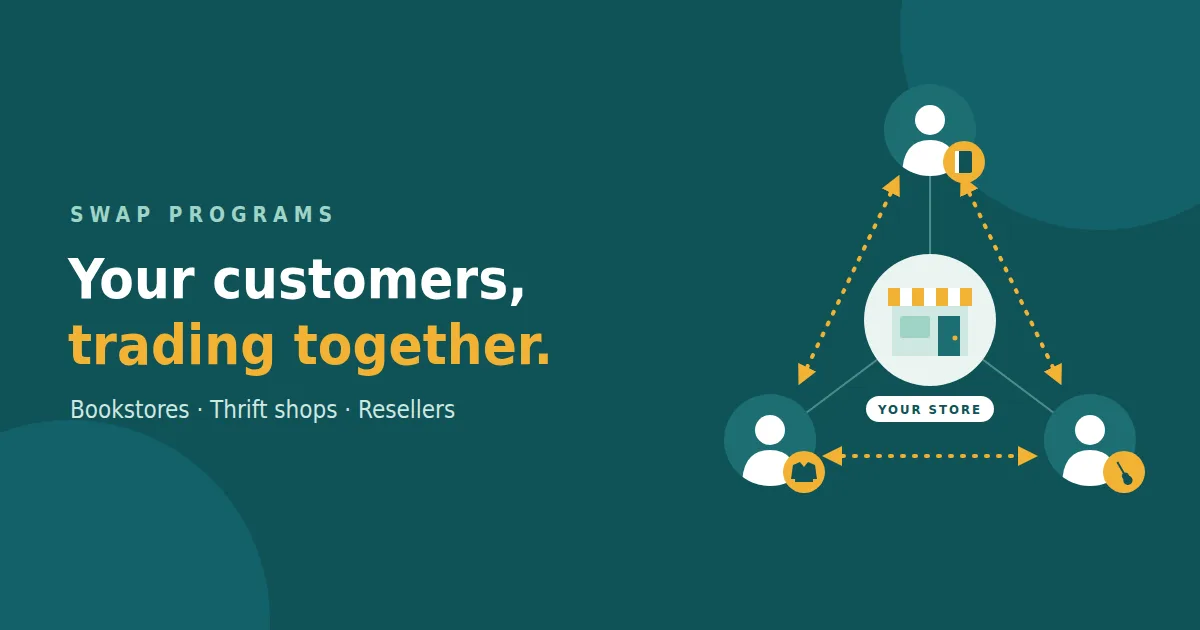
That's why TBBN is built to bring in businesses as well as individuals. Stores can connect their inventory to the marketplace, and cross-merchant matching means a customer's item can be matched against inventory at a different participating store entirely. A single shop has only its own shelves to offer. A connected network has everyone's.
How to get better matches
You can help the engine work for you:
- Fill in your wants. It's the most heavily weighted factor. A listing without wants is much harder to match.
- Be accurate about category, brand, and condition. These details make up nearly half the score.
- Price honestly. A realistic original price keeps value gaps small and makes your trades easier to accept.
- Build your reputation. Describe items accurately and follow through on trades. It counts.
- Keep wants open enough to get offers, and tighten them if you're getting matches you don't want.
For businesses: plug into the matching engine
If you run a store, you don't need to build any of this yourself. TBBN's matching engine connects to your platform through an API, SDKs, embeddable widgets, or a plugin. Your listings are matched against wants across the network, while you keep your own prices, checkout, tax, and fulfillment.
See how TBBN works · Set up your business
The bottom line
For 150 years, the double coincidence of wants has been the standard explanation for why barter doesn't work. But even Jevons could see that the real problem was finding each other, and Roth's work proved that a good matching system with enough participants can solve it.
TBBN applies that idea to everyday trades. Tell it what you have and what you want, and it does the searching for you.
List an item and add your wants · Browse the marketplace
Sources
- William Stanley Jevons, Money and the Mechanism of Exchange (1875), Chapter 1, via the Library of Economics and Liberty
- Alvin E. Roth, Tayfun Sönmez, and M. Utku Ünver, Efficient Kidney Exchange: Coincidence of Wants in Markets with Compatibility-Based Preferences, American Economic Review
- Freakonomics Radio, Make Me a Match, interview with Alvin Roth
- eBay Inc., Nobel Winner Alvin Roth Solves Tough Problems with Market Design
- UBS Nobel Perspectives, Alvin Roth
- TBBN, How TBBN works and Use cases


0 comments
Log in or create a free account to join the conversation.
Loading comments…