

How to Trade Without Ever Meeting: Drop-Off and Pickup Explained
The hardest part of a local trade usually isn't agreeing on a price. It's finding a time to meet a stranger. TBBN Space drop-off and pickup removes the meeting entirely: one person leaves the item with a host, the other collects it on their own schedule. Here's exactly how it works.
By Promise Ebere Okoroji · · 7 min read

Anyone who has sold something locally knows how it goes. You agree on a price in five minutes, then spend two days trying to find a time you're both free. Someone runs late. Someone cancels. Someone stops replying an hour before the meeting. And when you finally do meet, it's with a stranger, in a parking lot, hoping everything goes smoothly.
For many trades, the meeting is the least useful part. You don't need to shake hands with the other person. You just need the item to get from them to you, safely and with a clear record of what happened.
That's the idea behind drop-off and pickup at TBBN Space.
What is drop-off and pickup?
Drop-off and pickup is one of the four ways to book a TBBN Space. Instead of meeting the other trader, one person leaves the item with a local host, and the other person collects it later, on their own schedule.
The two traders never have to be in the same place at the same time. They don't need to share addresses or phone numbers, and neither has to wait around for the other.
Spaces are real, ongoing locations hosted by local businesses and individuals, such as a shop with a secure counter, a café, a coworking space, or a community center. Every booking appears on the host's calendar, with the time, the service, and who's coming.
How it works, step by step
1. Agree on the trade
First, the two traders agree on the trade on TBBN: who is giving what, and whether anyone is paying a difference in value. Every item on TBBN is listed with an original price, so both sides can see what each item is worth before agreeing.
2. Book a drop-off Space
Next, choose a Space near you that offers drop-off and pickup. Whoever makes the booking pays the host's fee. Before you book, look at two things in the Space's details:
- Hold time. Each host sets a maximum time an item can wait to be collected. Make sure the person picking up can get there within that window. Once the hold time expires, the host takes charge of the item, unless you've made a special arrangement with them.
- Liability terms. Each Space shows whether the host accepts liability for items left there and, if so, up to what amount. Check this before booking, especially for valuable items.
3. Drop off the item
When you book, you get a drop-off PIN. At the Space, you give the host your PIN and leave the item.
You also photograph the item through the booking's handover page. This creates a record of the item's condition at the moment it was handed over.
4. The other person picks it up
The person collecting the item comes in at a time that suits them, within the hold time. They give the host their own PIN, collect the item, and photograph it through the same handover page.
That's it. The item has changed hands, and there's a photo record from both ends of the handover.
5. For a two-way swap, book each item separately
If both people are handing over an item, each item gets its own drop-off and pickup, booked individually. Each one goes through the same process: dropped off with a PIN and photos, then collected with a PIN and photos. Neither person has to coordinate a meeting with the other.
Why the PINs and photos matter
It helps to be clear about the host's role. The host checks PINs. The host does not inspect, test, or appraise the item. The people trading take the photos.
That's deliberate. A café owner can't be expected to tell whether a laptop works or whether a pair of sneakers is authentic. What a host can reliably do is make sure the right person drops off and the right person picks up.
The photos do the rest. Because both traders photograph the item through the handover page, there's a record of its condition when it went in and when it came out. If there's ever a disagreement about what was left, the record shows what happened.
What about payment?
TBBN doesn't take part in payments between individual traders. If one side owes the other a difference in value, the two people agree on how to settle it themselves.
Because you won't be meeting face to face, it's worth agreeing on a payment method in advance and following a few simple rules:
- Only send payment once you get a drop-off confirmation. That way you know the item is actually waiting for you at the Space before any money changes hands.
- If you're receiving money, check that it has really arrived by opening your banking or payment app yourself. Don't rely on a screenshot, a confirmation email, or a link the other person sends you.
- Never accept more than the agreed amount, or any request to refund an "overpayment." The FTC warns that these are common scams.
- Avoid checks, gift cards, and wire transfers from people you don't know.
- Keep your messages on the platform, so there's a record of what you agreed.
Items listed by participating merchants work differently. Those are paid for through checkout and shipped by the merchant under its own policies, so there's no drop-off involved at all.
When to use drop-off, meetup, or shipping
Each option suits different trades:
- Drop-off and pickup is best when your schedules don't line up, when you'd rather not meet a stranger, or when the item is easy to judge from photos and a description, such as books, clothing, games, or small household items.
- A meetup at a Space is best when you want to inspect the item together before completing the trade, such as electronics you want to test, instruments you want to play, or anything where condition really matters. You can also book both: a meetup and a drop-off window on the same booking.
- Shipping makes sense when the other trader is far away. Buying from a participating merchant is always shipped and fulfilled by the merchant.
For high-value items, either meet at a Space so you can inspect the item together, or choose a drop-off Space whose host accepts liability up to a high enough amount.
A quick drop-off checklist
- Agree on the trade, including any difference in value, before booking.
- Check the Space's hold time and liability terms.
- If you're paying, wait for the drop-off confirmation before you send money.
- If you're being paid, confirm the money is in your account by checking it yourself.
- Package the item so it's protected and clearly yours.
- Take clear photos through the handover page at drop-off and at pickup.
- Collect promptly, within the hold time. After it expires, the host takes charge of the item unless you've arranged otherwise.
- Keep your PIN private. Share it with no one except the host.
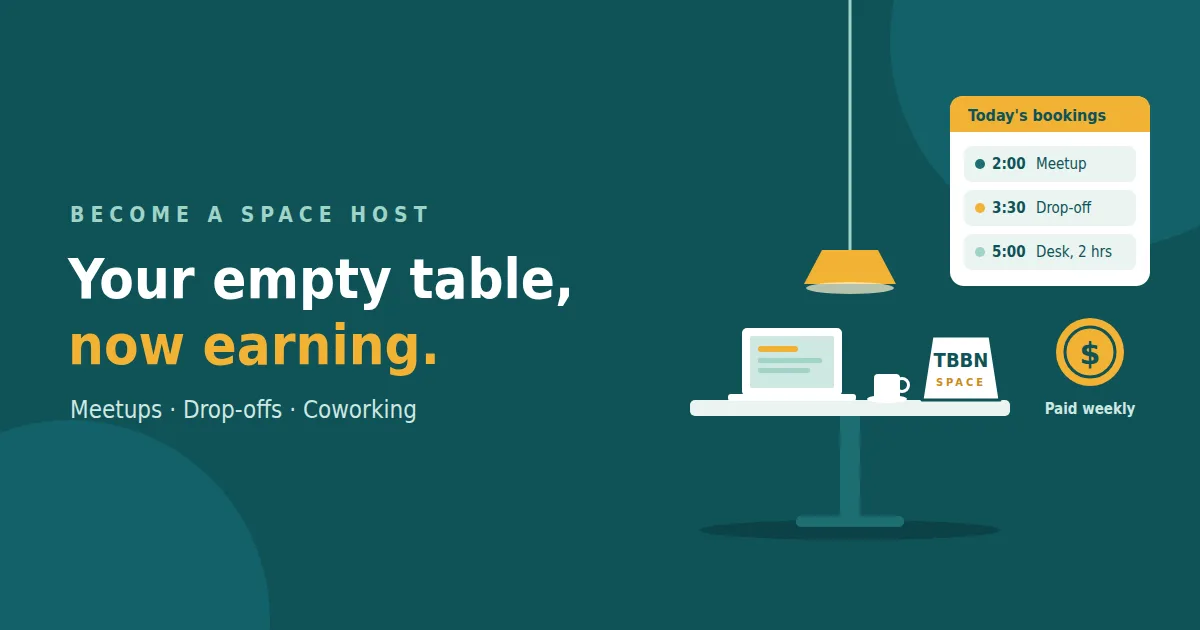
Hosting drop-offs: the easiest way to earn from your space
If you run a shop, café, coworking space, or community center, drop-off and pickup may be the simplest service you could offer.
You don't need a meeting room or a spare table. A secure counter or a corner of a back room is enough. You don't supervise meetings, and you don't inspect items. Your job is to check each PIN when someone drops off or picks up.
As a host, you:
- Earn a fee for hosting each handoff, on top of your regular business.
- Set your own maximum hold time, so items don't sit on your shelves indefinitely. Once it expires, uncollected items are in your charge, unless you've made a special arrangement with the trader.
- Set your own liability terms, shown clearly to traders before they book.
- See every booking on your calendar, with the time, the service, and who's coming, and track your payouts in one place.
- Bring in new foot traffic. Every person dropping off or collecting an item is a potential customer, and they're often coming in during quieter hours.
Businesses with several locations can also manage their Spaces through the TBBN Space API.
Become a TBBN Space host or see how local retailers use drop-off Spaces.
The bottom line
Most local trades don't need a meeting. They need a safe place for the item to change hands, a way to make sure the right people are involved, and a record of what happened. Drop-off and pickup at a TBBN Space provides all three: a local host, a PIN for each person, and photos at both ends of the handover.
No scheduling back-and-forth, no waiting in a parking lot, and no meeting a stranger.

0 comments
Log in or create a free account to join the conversation.
Loading comments…