

How Small Businesses Can Reach New Local Customers Without Adding Inventory
Most ways to bring in new customers cost money up front: discounts, ads, or more stock. Trade-in turns the things your customers already own into a reason to walk through your door. Here's how a trading program works for a small business, what it costs, and how to launch one without rebuilding your store.
By Promise Ebere Okoroji · · 6 min read
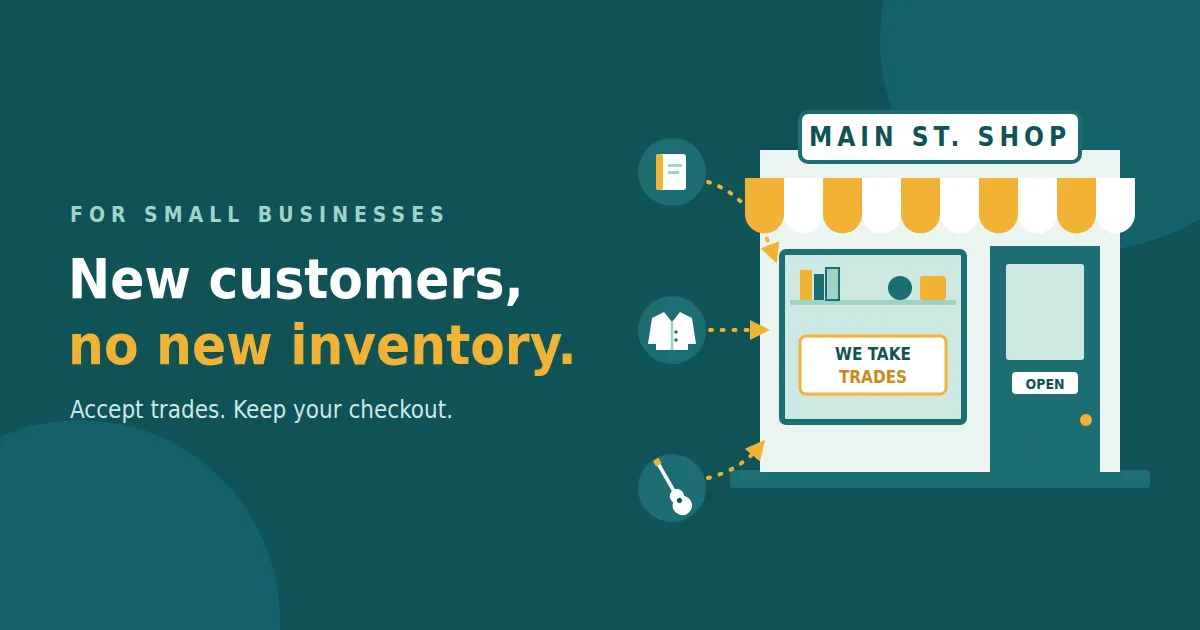
If you run a small shop, you know the usual ways to bring in new customers. You can run a sale and give away margin. You can pay for ads and hope they convert. Or you can buy more stock to give people a reason to come back, and tie up cash you may not have.
Each of these costs money before it brings any in.
There's another option that most small businesses overlook: the stuff your customers already own. Nearly everyone has something sitting in a closet that still has value, such as a guitar they've outgrown, last term's textbooks, or a jacket that no longer fits. A trading program lets them put that value toward something on your shelves.
Why this matters now
Secondhand is no longer a niche. According to ThredUp's 2026 Resale Report, produced with the retail analytics firm GlobalData, the U.S. secondhand apparel market grew 19% in 2025, its strongest year since 2021, and outpaced the broader clothing market by about 3.6 times. The same report expects Gen Z and millennials to drive more than 70% of the market's growth through 2030.
That's apparel alone, but the habit carries over. A growing share of shoppers think about what something will be worth later, and what they could trade it for. A store that welcomes those customers gives them a reason to choose it over a store that doesn't.
How a trading program works
TBBN is a trade engine that plugs into the store you already run. Here's what that looks like in practice.
You list your trade-eligible stock once. You decide which items can be traded for, and you set your own prices and condition standards. TBBN never sets or discounts your prices.
Customers offer what they have. A customer offers their item, or several items, toward something in your store. TBBN's matching engine finds compatible trades based on what each side has and wants.
TBBN does the math. Every item carries an original price, and TBBN calculates the difference in value automatically. Your staff don't have to appraise every offer at the counter.
Your checkout handles the sale. Once a trade is accepted, TBBN reserves the items on both sides and sends the customer to your own checkout. TBBN passes along the original price and the trade amount, so your checkout calculates tax and commission exactly as it would for a normal sale. You remain the merchant of record.
You fulfill as soon as you're paid. The moment your checkout completes, TBBN notifies your system, and you can ship right away. You never wait on the other side of the trade. Shipping, returns, and customer service stay with you, under your own policies.
And TBBN never takes a cut of what a trade is worth.
Reaching customers you don't have yet
A trade-in counter brings in customers who already know your store. TBBN goes further.
With global listing, your trade-eligible stock appears in the TBBN Marketplace, in front of people who are actively looking to trade. They may never have heard of your store. They found you because you have something they want and you'll accept what they have.
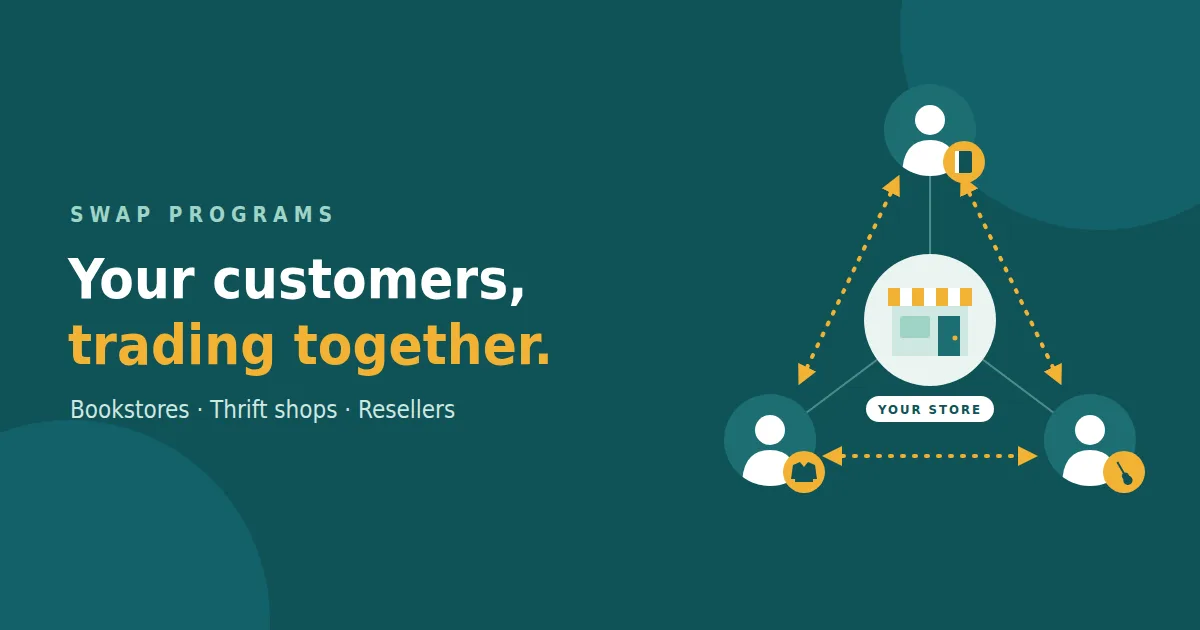
Cross-merchant matching widens that further. A single store can only offer trades against its own shelves. On TBBN, a customer's item can be matched against inventory at a different participating store entirely. You reach demand and supply beyond your own four walls, without carrying more stock.
If you'd rather keep trading inside your own community, a private setup lets you run trades only among your own customers or members, inside your own app or site.
What it looks like for different businesses
Here are a few ways businesses use TBBN, from TBBN's use cases:
- Independent bookstores run a standing trade-in program, where customers bring in books they're done with in exchange for something new off the shelf.
- Musical-instrument shops offer trade-ups, where a player puts a starter instrument plus the difference toward something better.
- Thrift and consignment shops add a widget to their storefront and offer store credit or a direct swap, whichever they prefer.
- Gyms and fitness studios let members swap gear they've outgrown, limited to their own members if they like.
- Vintage and resale stores use cross-merchant matching to offer far more than their own inventory.
Choosing how to connect
TBBN offers four ways to integrate, all reaching the same network. Pick the one that matches your team:
- Plugin: the fastest route for online stores. A Shopify plugin is available now, with WooCommerce, Magento, and BigCommerce listed as coming next.
- Widgets: embed a trade button, an offer window, or a trade inbox with a script tag. This is built for businesses with little or no engineering team.
- SDKs: typed clients for JavaScript, React, Next.js, and more, for teams building their own experience.
- API: full control for teams that want to build everything themselves.
You can try everything in a free sandbox before committing.
What it costs
TBBN charges merchants for their plan, and never charges your customers directly. As of October 2026, the plans are:
- Sandbox (free): test keys, full docs, and SDK access to evaluate the API.
- Starter ($100/month): global listing and trading, with monthly allowances for listing syncs, searches, and trade sessions.
- Growth ($250/month): adds private listing, embeddable widgets, a white-label option, more trade sessions, and priority support.
- Enterprise (contact TBBN): private trading between enterprises, dedicated infrastructure, and custom terms.
- Pay-as-you-go ($5 minimum per week): no fixed commitment, billed weekly on actual usage.
Every plan includes a $1.50 fee per completed checkout, plus small metered charges for usage beyond what's included. Cross-merchant trades are metered at four times the standard rate. You can build the checkout fee into what you charge at checkout, or absorb it yourself. Check the pricing page for current details.
Questions to settle before you launch
A trading program works best when the rules are clear from day one. Before you go live, decide:
- Which items are trade-eligible, and which aren't.
- Your condition standards, so customers know what you'll accept.
- Whether you offer a direct swap, store credit, or both.
- How you'll handle returns on traded items.
- How your staff will explain it, so the program is easy to understand at the counter.
It's also worth confirming how trades are treated for tax with your accountant, since you remain the merchant of record.
A second way to earn: become a Space host
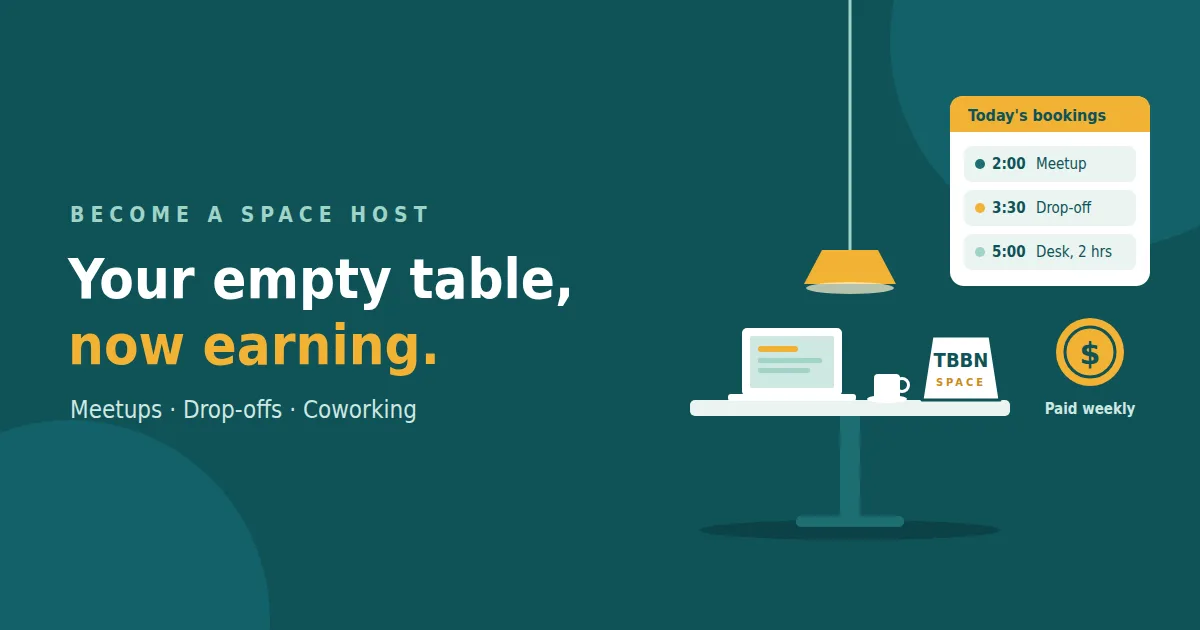
If your store has a quiet table, a spare desk, or a secure counter, you can also list it as a TBBN Space. Traders book Spaces to meet safely or to drop off items for each other, and you earn a fee for each booking. It brings in foot traffic, often during hours that would otherwise be slow, and requires no integration at all.
How to get started
- Create your business account at business.tbbnetwork.com.
- Explore the sandbox and pick an integration path.
- Choose your trade-eligible stock and set your pricing and condition rules.
- Go live, and tell your customers. A sign at the counter that says "We take trades" goes a long way.
The bottom line
Discounts give away margin, ads cost money up front, and extra stock ties up cash. A trading program works differently: it turns what your customers already own into a reason to visit your store, and opens your shelves to people across the network who never knew you existed.
You keep your prices, your checkout, and your customers. TBBN handles the matching and the math.
Set up your business · See how it works · Request a demo
Sources
- ThredUp, 14th Annual Resale Report press release (April 2026)
- Chain Store Age, ThredUp: U.S. secondhand apparel sales to hit $78.8B by 2030
- TBBN, How TBBN works, Use cases, Solutions, and Pricing

0 comments
Log in or create a free account to join the conversation.
Loading comments…