
What Is Trade by Barter in 2026? A Modern Guide to Swapping Instead of Spending
Prices keep climbing, closets keep filling, and most of us own things we no longer use. Barter is one of the oldest answers to that problem. Here is how it works today, where it used to break down, and what a modern trade looks like from listing to handoff.
By Promise Ebere Okoroji · · 7 min read
Most households are sitting on hundreds of dollars of things they no longer use: a camera that hasn't left its bag in two years, a bike the kids outgrew, a stack of books already read, a kitchen gadget that seemed like a good idea at the time. At the same time, those same households are paying full price for things they need.
That gap is the reason barter exists. It is one of the oldest ways people have exchanged value, and it is quietly making a comeback. This guide explains what trade by barter is, why it fell out of everyday life, why it is returning, and what a modern trade actually looks like.
What is trade by barter?
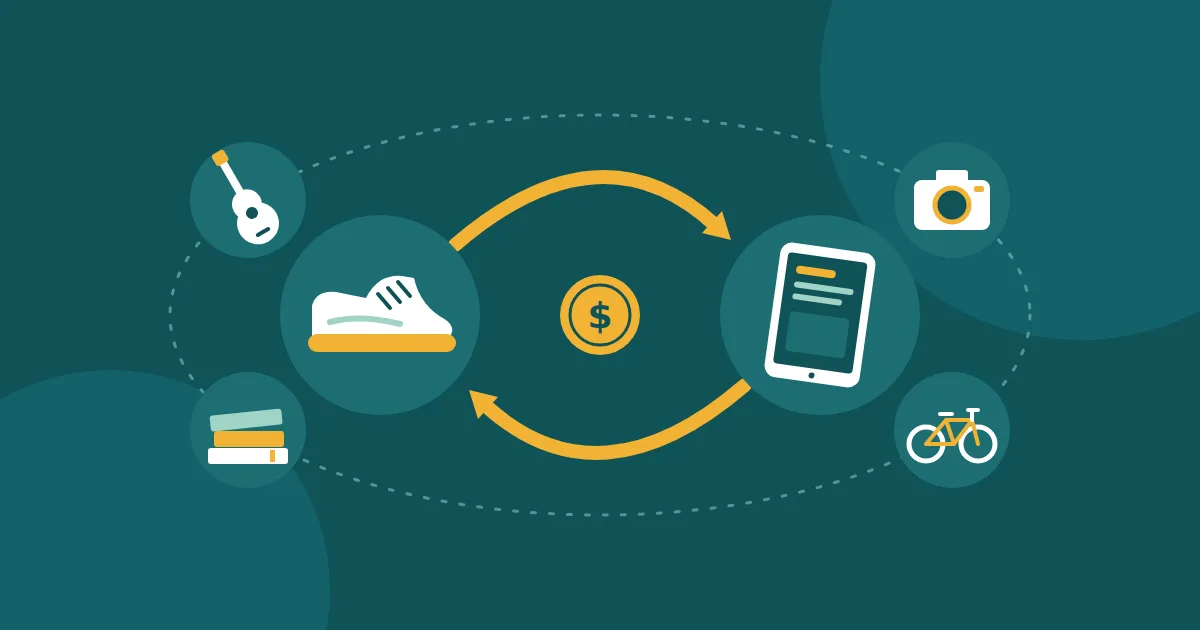
Trade by barter is the direct exchange of goods or services without using money as the go-between. I give you my guitar, you give me your tablet. A plumber fixes a café owner's pipes and gets a month of lunches in return. No cash changes hands, or only a small amount to even things out.
That last part matters, and we'll come back to it. Pure barter, where two items must be worth exactly the same, is rare. Most real-world trades involve barter plus a top-up: swap the items, and whoever is getting more value pays the difference.
A quick, honest history
You may have learned in school that people bartered first and then invented money because barter was too clumsy. It is a tidy story, but anthropologists have found little evidence that whole societies ever ran purely on barter. In practice, communities used a mix of gifts, credit, and favors, and barter showed up mostly between strangers, or when money was scarce.
That second part is the interesting one. Barter tends to surge when cash is tight or untrustworthy: during recessions, currency crises, and times of high inflation. It has never really disappeared. Businesses trade services with each other, neighbors swap tools, and parents hand down clothes in exchange for something else. What changed is that barter became hard to do at scale.
Why barter fell out of everyday life
Economists have a name for barter's biggest weakness: the double coincidence of wants. For a trade to happen, you need to find someone who has what you want and wants what you have, at the same time, in the same place.
If you have a guitar and want a tablet, you don't just need someone with a tablet. You need someone with a tablet who is also looking for a guitar. Before the internet, finding that person was mostly luck. Money solved the problem by acting as something everyone accepts, so you could sell the guitar to one person and buy the tablet from another.
Barter had a few other problems too:
- Uneven values. A $150 pair of sneakers and a $380 tablet don't line up, and haggling over the gap is awkward.
- Trust. You're handing your item to a stranger and hoping theirs is as described.
- Logistics. Someone has to pick a place to meet, and meeting a stranger from the internet carries real risk.
None of these are reasons barter is a bad idea. They are reasons it was hard to do. That is a solvable problem.
Why barter is coming back
Several pressures are pushing people back toward trading:
- Cost of living. When everyday prices rise, swapping something you don't use for something you need is a way to stretch your budget without spending more cash.
- Selling is a hassle. Listing an item for sale often means lowball offers, endless "is this still available?" messages, and fees. Many people would happily trade instead, if trading were easy.
- Waste. Usable items end up in landfills or storage units. Trading keeps them in use and gets them to someone who wants them.
- Community. A trade is a small act of cooperation. It connects people locally in a way an anonymous checkout doesn't.
- Technology. The problems that held barter back — finding a match, evening out values, and meeting safely — are exactly the kinds of problems software is good at.
What modern barter looks like
This is where TBBN (Trade by Barter Network) comes in. We built TBBN around the specific reasons barter used to fail, so that trading is as easy as buying. Here's how each problem is handled.
Finding a match: say what you'd take instead
When you list an item on TBBN, you don't just describe what you have. You also say what you'd accept in return. That turns the double coincidence of wants from a matter of luck into a matching problem. Our trade-compatibility engine looks for people whose wants line up with yours, so you're browsing real potential trades rather than scrolling through listings hoping one fits.
You can also list for sale, for trade, or both, so you're never locked into one option.
Uneven values: pay only the difference
Here's a real example of how TBBN handles a mismatch. Jordan has a pair of Nike Air Max 90s and values them at $175. Maria has an iPad Mini worth $380. They agree to swap, and Maria pays Jordan the $205 difference.
Nobody has to haggle over how to make two items "equal." The value gap is shown upfront, and each person pays their own side through their own checkout, in either order. Each shipment starts as soon as that side has paid, so nobody is left waiting on the other person.
Meeting safely: TBBN Space
The riskiest part of any person-to-person trade is the handoff. Meeting a stranger in a parking lot or giving out your home address is how a lot of marketplace trades go wrong.
TBBN Space is a network of real, hosted locations where you can meet another trader in person, or skip meeting entirely by dropping off your item for the other person to collect on their own schedule. Spaces are hosted by individuals and local businesses, and every booking appears on the host's calendar with the time, the service, and who is coming.
If you do meet up somewhere else, the basics still apply: choose a public, well-lit place, bring a friend or tell someone your plans, inspect the item together before you finish the trade, and never send money or financial information before you've met.
Businesses can trade too
Barter isn't only for individuals. Bookstores, thrift shops, resellers, and other businesses can connect their store to the TBBN marketplace through an API, SDKs, embeddable widgets, or a plugin. They keep their own checkout, tax, and fulfillment, and they reach local shoppers who want to trade rather than pay full price. TBBN never takes a cut of what a trade is worth.
Is barter right for you?
Trading works especially well if:
- You have items in good condition that you no longer use, but selling them feels like more trouble than it's worth.
- You want something specific and would rather put an unused item toward it than pay full price.
- You care about keeping usable things out of landfills.
- You run a business with stock to move or a space that could bring in new foot traffic.
It is less suitable for things you need urgently, or for items whose value is hard to judge without an expert. A rare collectible may be better off appraised first.
One practical note: in many countries, including the United States, the value of what you receive through barter can count as taxable income, especially for businesses. If you trade regularly or as part of a business, it's worth checking with a tax professional.
How to make your first trade
- Pick one item you don't use. Start with something easy to describe and value, like electronics, sneakers, books, or tools.
- List it with clear photos and an honest description. Note any wear or flaws. Trust is what makes barter work.
- Say what you'd take instead. Be specific enough to get good matches, but open enough to get offers.
- Review offers and the value difference. Accept when the trade feels fair to you.
- Choose how to hand off. Ship it, meet at a TBBN Space, or use drop-off and pickup.
Listing on TBBN is free, with no fees currently. The worst outcome is that your unused item sits on TBBN instead of in your closet.
The bottom line
Barter never failed because it was a bad idea. It failed because finding a match, evening out values, and meeting safely were too hard. Those are exactly the problems TBBN was built to solve. The things you no longer use still have value, and someone nearby probably wants them.
List your first item or browse what people are trading near you.
0 comments
Log in or create a free account to join the conversation.
Loading comments…